How to Order at a French Restaurant When You Don't Speak French
By: Jean-Paul and Jessica - Published March 4, 2026
Ordering at a French restaurant follows a clear sequence: say bonjour (bon-ZHOOR) when you arrive, wait to be seated, order drinks first, use "je voudrais" (zhuh voo-DRAY) plus a point to order food, and ask for the bill with "l'addition, s'il vous plaît" (lah-dee-SYOHN seel voo play) when you are ready to leave. You do not need to speak French. You need about five phrases and the ability to point.
This guide walks you through exactly what happens at each stage of the meal, what to say, and what to expect.
What French Menu Words Do Americans Get Wrong?
Three French menu terms trip up almost every American visitor. "Le menu" (luh muh-NOO) means a fixed-price meal, not the booklet of options. "L'entrée" (lon-TRAY) means the starter course, not the main dish. "La formule" (lah for-MYOOL) is the term for a set-price deal, not "prix-fixe" (pree-FEEKS). Getting these three straight prevents the most common ordering mistakes.
"Le menu" is not the menu. In France, "le menu" (luh muh-NOO) means a fixed-price set meal, usually two or three courses for one price. What Americans call "the menu" (the booklet listing all the options) is called "la carte" (lah kart). When a server asks if you want "le menu," they are asking if you want the set deal, not handing you a list.
"Entrée" is not the main dish. In France, "l'entrée" (lon-TRAY) is the starter course. Your main dish is called "le plat" (luh plah) or "le plat principal" (luh plah pran-see-PAL). American English borrowed the word entrée from French in the 19th century and attached it to the wrong course. Do not order an entrée expecting a steak.
Jessica: "I made the entrée mistake on my very first trip to Paris. I ordered what I thought was my main course and a small salad arrived. I sat there confused while my travel companion's steak showed up. Learn from me on this one."
"Formule" is the word you actually want. When you see a fixed-price option on a French menu, it will be listed as "le menu" (luh muh-NOO) or "la formule" (lah for-MYOOL). That is the phrase to know. If you say "prix-fixe" (pree-FEEKS) to a server, they will understand you, but it marks you immediately as someone who learned French dining from an American restaurant.
What Happens When You First Sit Down at a French Restaurant?
When you sit down at a French restaurant, someone seats you, hands you la carte (lah kart), and leaves you alone. A server will come to ask about drinks, bread will arrive at the table automatically and free of charge, and the server will not hover or check in repeatedly. That last part is intentional.
One thing to do the moment you walk in: say "Bonjour" (bon-ZHOOR) to whoever greets you. In France, greeting someone before making any request is not optional politeness. Skipping it reads as rude regardless of what comes after.
Jean-Paul: "The bonjour is how we acknowledge the person in front of us before we ask anything of them. When someone walks in and immediately starts pointing at a table or asking questions in English, we notice. It is a small thing that changes the entire interaction."
For drinks, you can order wine, a beer, or water. This is the apéritif (ah-pay-ree-TEEF) moment. You can also say "non merci" (nohn mehr-SEE) and go straight to ordering food. Neither choice is wrong.
If the bread basket runs low, ask for more: "encore du pain, s'il vous plaît" (on-kor doo pan seel voo play).
How Do You Read a French Menu Without Speaking French?
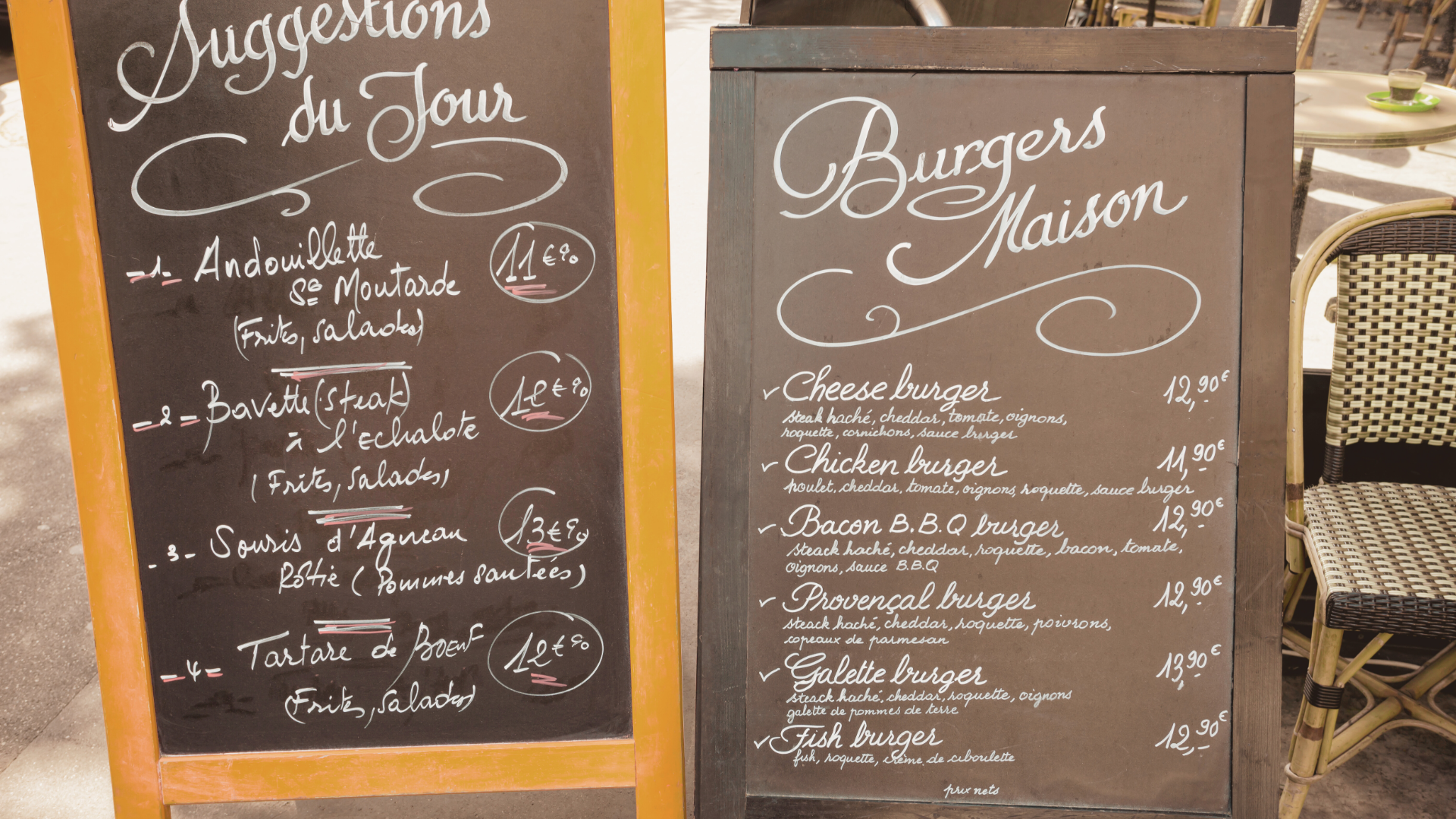
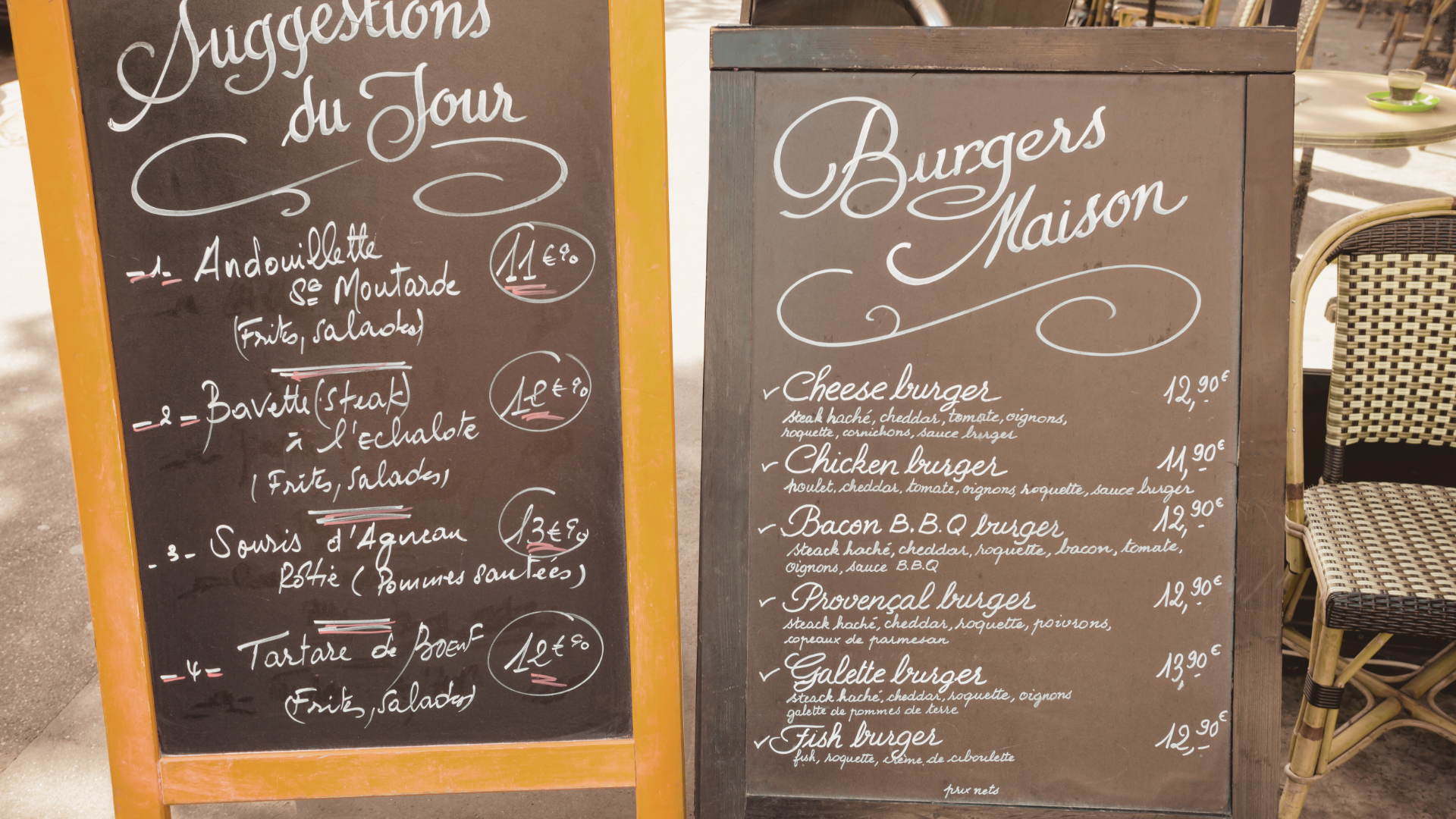
Every French menu follows the same structure: l'entrée (lon-TRAY, starters), le plat principal (luh plah pran-see-PAL, mains), le fromage (luh froh-MAHZH, cheese, always before dessert), le dessert (luh deh-SEHR), and le plat du jour (luh plah doo ZHOOR, the daily special, usually on a chalkboard near the entrance). Most menus in Paris tourist areas include English translations alongside the French. If yours does not, this structure is all you need.
L'entrée (lon-TRAY). Starters. Salads, soups, pâté (pah-TAY), small fish dishes. This is the first course.
Le plat principal (luh plah pran-see-PAL). Main courses. Usually divided into fish, poisson (pwah-SOHN), and meat, viande (vyahnd).
Le fromage (luh froh-MAHZH). The cheese course. It comes before dessert, not after.
Le dessert (luh deh-SEHR). Desserts.
Le plat du jour (luh plah doo ZHOOR). The daily special. Often the best value on the menu, written on a chalkboard near the entrance rather than in la carte itself.
La formule (lah for-MYOOL) or le menu (luh muh-NOO). The fixed-price option. Usually a choice of entrée plus plat, or plat plus dessert, for a set price. At lunch this is almost always the most economical way to eat well.
Worth knowing: the same restaurant will often charge noticeably less at lunch than at dinner for food that is nearly identical. If you have flexibility in your schedule, eating your main meal at midday is how Parisians get the most out of a good kitchen without the dinner bill.
To ask about a dish, catch your server's eye and say "Excusez-moi, qu'est-ce que c'est?" (ex-kew-zay mwah, kess-kuh-say), which means "Excuse me, what is this?" Servers in Paris are used to tourists. Most will either explain in English or describe it with enough context to help.
What Do You Say to Order Food at a French Restaurant?
To order food at a French restaurant, say "je voudrais" (zhuh voo-dray, meaning "I would like") and point at the item on the menu. To get the server's attention first, make eye contact, raise one hand slightly, and say "Excusez-moi" (ex-kew-zay mwah). That covers it.
To get the server's attention: Make eye contact and raise one hand slightly, or say "Excusez-moi" (ex-kew-zay mwah). Do not snap your fingers. Any server in the restaurant can help you, not only the one who seated you.
To order: "Je voudrais..." (zhuh voo-dray) means "I would like..." Follow it by pointing at the menu item if you cannot pronounce it. This is completely normal and no one will find it odd.
To ask what something is: "Excusez-moi, qu'est-ce que c'est?" (ex-kew-zay mwah, kess-kuh-say) means "Excuse me, what is this?"
One practical note on steak: if you order beef and the server asks how you want it cooked, the French scale runs saignant (sen-YAHN, rare), à point (ah-PWAN, medium), and bien cuit (byaN-KWEE, well done). If you usually order medium-rare in the US, order à point in France. French kitchens run slightly less done than American ones, so going one step up puts you in the right place.
One practical note on sending food back: if something arrives and you do not like it, the French expectation is that you eat it. Sending a dish back because it is not to your taste, as opposed to being incorrect or genuinely inedible, is uncommon and lands awkwardly. Order carefully, and use "Excusez-moi, qu'est-ce que c'est?" before you commit to anything unfamiliar.
Why Does the Waiter Seem to Be Ignoring You?
The server is not ignoring you. French restaurant service is built around leaving diners alone, and checking in repeatedly is considered disruptive. The server will return when they judge you are ready, or when you signal them.
Jean-Paul: "In France, a meal is protected time. When I was growing up, Sunday lunch lasted three hours and no one thought anything of it. The server who disappears after bringing your food is doing their job correctly. They are giving you the meal. The server who comes back every ten minutes to ask if everything is okay is the one doing it wrong, at least by our standards."
You finish your entrée, your plat has not arrived, and nothing seems to be happening. This is normal. A French meal routinely runs two hours and the kitchen paces courses deliberately. If twenty minutes have passed and you are concerned, a calm "Excusez-moi" to any passing server is fine. In most cases, the food is coming and no one has forgotten you.
Jessica: "It took me three trips before I stopped reading the pace as a problem. Now it is my favorite part. No one is rushing you out. You paid for that table and that time. Sit, talk, have another glass of wine. The check will not come until you ask for it."
To get someone's attention, catch their eye and raise your hand slightly, or say "Excusez-moi" when one passes nearby. A direct "Excusez-moi, monsieur" (ex-kew-zay mwah, muh-SYUH) or "Excusez-moi, madame" (ex-kew-zay mwah, mah-DAM) works every time.
How Do You Ask for the Bill in France?
To ask for the bill in France, say "L'addition, s'il vous plaît" (lah-dee-syohn seel voo play). The bill will never arrive on its own. Bringing it without being asked is considered presumptuous in France, as if the restaurant is rushing you out. You have to ask.
The server will bring a small tray with the bill on it. You place your card or cash on the tray and they return to process it.
If you pay by card, the server brings the machine to your table. They do not take your card away. You insert it or tap it yourself, right there. This differs from the US practice of a server disappearing with your card.
Do You Need to Tip at French Restaurants?
Tipping is not required at French restaurants. A service charge is included in the price of every meal by law, so the server's wage does not depend on what you leave on the tray. Leaving a few euros is a gesture of appreciation, not a requirement.
If you want to tip, leave coins or a small bill in cash on the tray when you collect your card. Around 5 to 10% is generous by French standards. There is no tip line on a French card machine the way there is in the US.
How Do You Get Free Water at a French Restaurant?
To get free tap water at a French restaurant, ask for "une carafe d'eau, s'il vous plaît" (oon kah-raf doh seel voo play). If you ask for "water" without specifying, you may receive a bottle of mineral water and be charged for it.
Tap water in Paris is safe to drink. Many French diners order a carafe rather than bottled water, and asking for it is completely normal.
If you do want bottled water, you need to specify. "Eau plate" (oh plaht) means still. "Eau gazeuse" (oh gah-ZUHZ) means sparkling. The server will bring a sealed bottle and you will be charged for it.
What Kind of Coffee Can You Order in France?
"Un café" (uhn kah-FAY) in France is a small, strong espresso, about two ounces. If you want something closer to American drip coffee, order "un café allongé" (uhn kah-fay ah-lon-ZHAY), an espresso with extra hot water added. A cappuccino is a perfectly reasonable order and comes as a proper espresso with steamed milk.
The order to know: "Un café allongé" (uhn kah-fay ah-lon-ZHAY). It is on every menu, closer in volume and strength to what most Americans drink, and will save you from staring sadly at a very small cup.
A cappuccino is fine to order any time. You will get espresso and steamed milk. No flavored syrups, no oversized cup, no foam art. That is the drink, and it is good.
Café au lait (kah-fay oh LAY) is a breakfast drink in France. Ordering it after dinner is unusual, though no server will refuse to make it.
Coffee comes after dessert, not with it.
Frequently Asked Questions
How do you order food at a French restaurant if you don't speak French? Say "je voudrais" (zhuh voo-DRAY) and point at the item on the menu. To ask what something is, say "Excusez-moi, qu'est-ce que c'est?" (ex-kew-ZAY mwah, kess-kuh-SAY), which means "Excuse me, what is this?" Those two phrases cover the entire ordering process.
What does entrée mean in France? In France, entrée (lon-TRAY) means the starter or first course, not the main dish. Your main dish is "le plat" (luh plah). Confusing the two is the single most common ordering mistake Americans make at French restaurants.
What does formule mean on a French menu? A formule (for-MYOOL) is a fixed-price meal combining two or three courses for a set price. At lunch, it is almost always the best value on the menu.
Do French restaurants have English menus? Many restaurants in Paris tourist areas carry English menus or bilingual descriptions. Smaller neighborhood spots may not, but asking "Avez-vous un menu en anglais?" (ah-vay-voo uhn muh-NOO on on-GLAY) is always reasonable.
Is tap water free at French restaurants? Yes. Ask for "une carafe d'eau, s'il vous plaît" (oon kah-RAF doh seel voo play) to receive it free. If you want bottled water, say "eau plate" (oh plaht) for still or "eau gazeuse" (oh gah-ZUHZ) for sparkling, and expect to be charged for it.
How do you ask for the bill in France? Say "L'addition, s'il vous plaît" (lah-dee-SYOHN seel voo play). The bill will never arrive on its own; you always have to ask.
Do you tip at restaurants in France? Tipping is not required. A service charge is already included by law. Leaving a few euros for good service is appreciated but nothing is expected.
How do you order steak in France? Use the French doneness scale: saignant (sen-YAHN) for rare, à point (ah-PWAN) for medium, bien cuit (byaN-KWEE) for well done. If you usually order medium-rare in the US, order à point (ah-PWAN). French kitchens run slightly less done than American ones.
Why does the waiter not come back to check on you in France? French dining culture treats repeated check-ins as disruptive. The server is leaving you alone on purpose. To get their attention, make eye contact and raise one hand, or say "Excusez-moi" (ex-kew-ZAY mwah) when one passes nearby.
What if I cannot pronounce anything on the menu? Point at it. Say "je voudrais" (zhuh voo-DRAY) and point. It happens constantly in French restaurants and no one will react with anything other than a nod.
About the Authors
Jean-Paul grew up in Burgundy and has lived in France his entire life. Jessica is American and has been traveling to France for more than twenty years. They started Bonjour Guide because the most useful information about France tends to be the hardest to find. Meet Jean-Paul and Jessica.